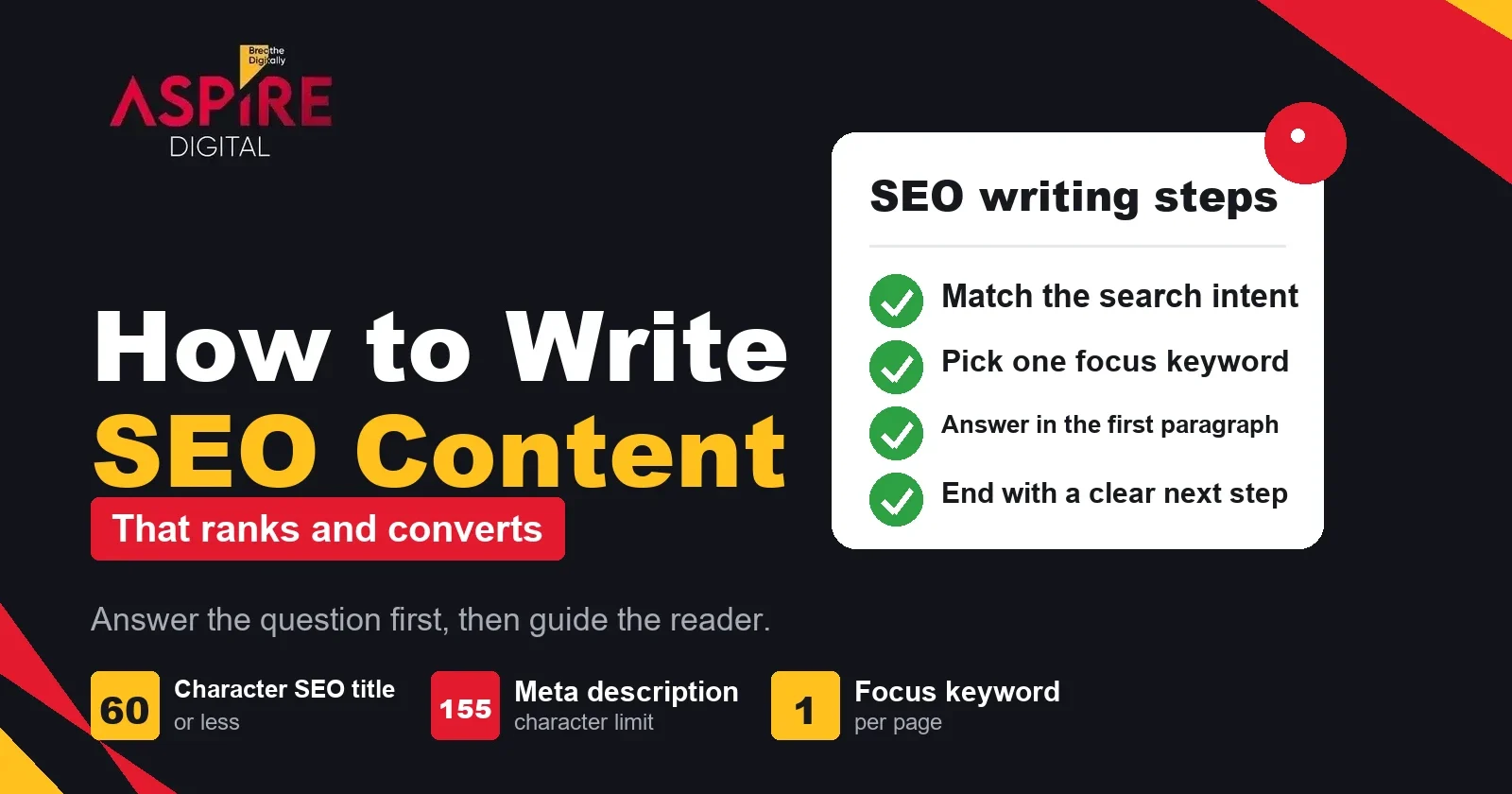
Quick answer: Writing SEO content means creating a page that answers the searcher's question better than the other results. Start with search intent, choose one focus keyword, plan clear headings, answer the question in the first paragraph, use keywords naturally and end with a clear next step for the reader. Write for people first, then check the structure.
Most SEO articles fail for one simple reason: they are written to include keywords, not to help the person who searched. If you need a team to plan and write pages that rank and bring enquiries, our content writers in Karachi can handle the research, outline and writing. If you want to understand the process before you brief anyone, this guide walks through each step.
Start with the search intent, not the keyword
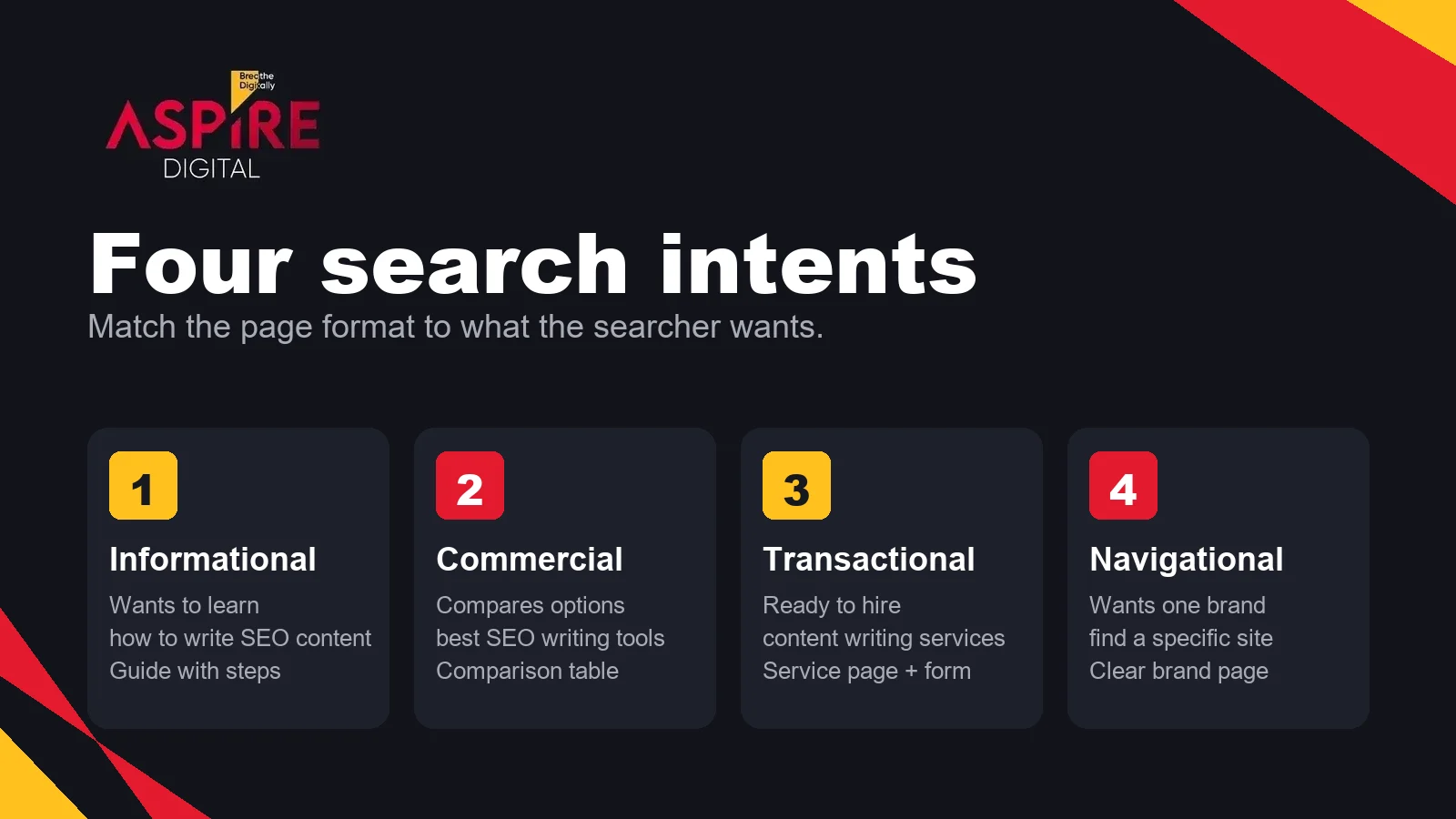
Search intent is the reason behind a search. Someone who types "how to write SEO content" wants steps and examples. Someone who types "content writing services in Karachi" wants to hire a person or agency. A page that tries to do both will usually satisfy neither. Before you write, search the keyword yourself, look at the top results and note what format they use. If they are all step-by-step guides, a sales page will struggle. If they are all service pages, a long essay will struggle.
| Intent type | What the searcher wants | Example search | Best page format |
|---|---|---|---|
| Informational | To learn or understand something | how to write SEO content | Guide with steps, examples and a checklist |
| Commercial | To compare options before buying | best SEO content writing tools | Comparison with clear criteria and a table |
| Transactional | To hire, buy or book | content writing services in Karachi | Service page with pricing logic and a contact form |
| Navigational | To find a specific site or brand | Aspire Digital blog | Clear brand page or homepage |
Matching the format to the intent is one of the fastest ways to improve a page. A guide on how to write SEO content should answer the question in its opening lines, then give the steps. A service page should explain what is included, who it suits and how to get started. Mixing the two makes both harder to read.
Pick one focus keyword and a few supporting terms
Each article should target one focus keyword, the main phrase the page is about. Add a small group of sub keywords that describe the same topic in other words, such as search intent, content structure or content that converts. Do not stack several unrelated targets onto one page. Two pages that aim at the same phrase compete with each other, and Google may show the wrong one or neither.
Before publishing, check your site for pages already targeting the same phrase. If one exists, either improve that page or choose a different angle for the new article. This avoids keyword cannibalization, where your own pages split the ranking signals for one search.
Plan the outline before you write
A good outline uses clear headings that a reader can scan. Each H2 should answer one question or cover one step. Each H3 should give a detail inside that step. Write the outline as questions, then check that the article answers every one of them. This also helps the reader decide quickly whether the page is useful, which keeps them on the page longer.
- Write the title and the focus keyword, then check that the title promises something specific.
- List the three to six questions a reader would ask about the topic.
- Turn each question into an H2, and add H3s only where the answer has several parts.
- Note where a table, checklist or example will explain the point faster than a paragraph.
- Add one internal link to a related page and one link to a trusted outside source.
Answer the question in the first paragraph
Readers and search engines both look for the answer near the top. Open with a short paragraph of about 40 to 60 words that answers the title directly. The rest of the article can then add depth, examples and nuance. This style also suits AI search tools, which often lift a short, clear answer from the page. For more on how answer-first content is shaped, read our guide on how to appear in Google AI Overviews.
Use keywords naturally in the places that matter
Keyword placement is about clarity, not repetition. Use the focus keyword in the places a reader and a search engine expect to see the topic. Then write the rest of the page in natural language. If a sentence reads awkwardly because of a keyword, rewrite it with a synonym. The table below lists the main places to check.
| Location | What to do | Quick check |
|---|---|---|
| SEO title | Put the focus keyword near the start | 60 characters or less |
| URL slug | Use the keyword in lowercase with hyphens | No dates or extra words |
| First paragraph | Use the keyword once, in a natural sentence | Reads like a normal sentence |
| One H2 | Include the keyword or a close variant | Heading still makes sense alone |
| Meta description | Summarise the answer and invite the click | 155 characters or less |
| Image alt text | Describe the image, include the keyword only if it fits | Useful to someone using a screen reader |
Write for the next step, not just the reader
A search visitor often arrives with a problem and a question about how to solve it. A strong article answers the question, then shows the next step. That step might be a checklist to download, a service page to read or a contact form to fill in. Keep the call to action specific. "Read our service page" is weaker than "see how our team writes and optimises service pages for Karachi businesses".
Trust matters too. Show who wrote the article, explain how the advice applies in practice and link to sources for any facts. Google's guidance on creating helpful content asks writers to focus on people first, with original information, clear expertise and content that satisfies the reader's need. Read the guidance on creating helpful, reliable, people-first content before you publish.
Link to related pages without forcing it
Internal links help readers move to the next useful page and show search engines how your site is organised. Link where the reader would naturally want more detail. A good example is the link to how quality content writing boosts your SEO in the section about quality. Avoid stuffing links into every paragraph. Three or four relevant links in a 1,500 word article is usually enough.
Measure the page and update it
Publishing is the start, not the end. Check Google Search Console after a few weeks to see which queries bring impressions and clicks. If the page ranks for a related query you did not target, add a short section that answers it. If it gets impressions but few clicks, rewrite the title and meta description so they match what the searcher expects. Update the article when facts or services change, and keep a note of the date.
SEO content writing checklist
- Search the focus keyword and note the format the top results use.
- Check that no other page on your site already targets the same phrase.
- Write a 40 to 60 word answer at the top of the article.
- Use H2 headings for each question and H3 headings for details.
- Place the focus keyword in the title, first paragraph, one H2, the URL and the meta description.
- Add a table or checklist where it makes the answer easier to use.
- Link to one service page and two related guides with clear anchor text.
- End with a specific next step and a short FAQ section.
- Review the page in Search Console after publishing and update it when needed.
Related guides: How Quality Content Writing Boosts Your SEO, Content Writing Tips for Persuasive Content and Content Writing Rates in Pakistan.
Frequently asked questions
How long should SEO content be?
Length should follow the question, not a fixed target. A simple guide often needs about 1,500 to 2,200 words to cover the steps, examples and FAQs properly. A short definition may need far less. Cutting filler and adding useful detail matters more than hitting a word count.
Do I need to use the keyword many times?
No. Use the focus keyword in the key places and let the rest of the text use natural language and synonyms. Repeating a phrase many times makes the text harder to read and does not improve the ranking. Clear coverage of the topic matters more.
Can AI write SEO content for me?
AI tools can help with research, outlines and first drafts, but the final page still needs checking. Add real examples, correct any facts, remove generic phrasing and confirm that the page answers the searcher's question. A person who knows the business should review the article before it goes live.
How soon will an SEO article rank?
There is no fixed timeline. Some pages begin to appear in search within weeks, while competitive topics can take months. Check Search Console, improve the page where it shows impressions but few clicks and build internal links from related articles to speed up discovery.