
Quick answer: How long does SEO take? For most business websites, the first clear improvement in rankings and traffic shows in 3 to 6 months. Competitive keywords and brand new websites often need 6 to 12 months or longer. Some technical fixes show up within weeks, but SEO builds over time: the results you see in month nine usually come from work done in months one to six.
As an SEO company in Karachi, the question we hear most after "how much does it cost?" is "when will I see results?". It is a fair question. You are paying every month, and unlike ads, SEO does not switch on the day you start. This guide gives you a realistic SEO timeline: why it takes time, what changes the speed, what should happen month by month, and how to tell whether your SEO is on track or quietly stuck.
Why SEO takes time
SEO is the work of making your website the best answer Google can show for a search. If you are new to it, our guide on what SEO is and how ranking works covers the basics. The short version is that several slow steps sit between a change on your website and a change in your traffic.
- Google has to find the change. Google says that crawling can take anywhere from a few days to a few weeks. Until a page is crawled and indexed, it cannot rank at all.
- Google has to reassess the page. In its SEO Starter Guide, Google notes that some changes take effect in a few hours while others can take several months, and suggests waiting a few weeks before judging whether a change worked.
- Trust builds slowly. Links from other websites, reviews and mentions of your brand add up over months. A website nobody has linked to yet starts at a disadvantage.
- Competitors are not standing still. The businesses already on page one are also publishing, earning links and improving their pages. You have to overtake them, not just catch up.
This is why SEO feels slow at the start and faster later. Early months go into fixing and building. Once Google trusts the site, new pages tend to rank more quickly.
What affects your SEO timeline
There is no single answer for every business, because the starting point and the competition are different each time. These are the factors that move the timeline the most.
The age and history of your website
An established domain with some existing rankings and links usually moves faster than a site launched last month. A site with a history of spammy links or a past penalty can be slower than a brand new one, because it first has to win back trust.
How competitive your keywords are
Ranking for "AC repair in Gulshan-e-Iqbal" is a very different job from ranking for "digital marketing agency Pakistan". The more established businesses chasing a search, the longer it takes. Specific, local and long-tail searches nearly always move first.
The current state of the website
If the site is slow, has crawl errors, broken links, duplicate pages or no clear page for each service, the first month or two goes into repairs. Those fixes do not always show as traffic straight away, but nothing else works properly without them.
Content and pages
Google can only rank you for what your website actually covers. A business with one generic services page will struggle to rank for ten different services. Each service, product group or location you want to be found for usually needs its own useful page.
Links and reputation
Links from relevant, trusted websites are still one of the strongest signals for Google. A site with no links can rank for easy local searches, but competitive keywords usually need a steady build of quality links over months.
How much work goes in each month
A campaign with a few hours of work a month will move more slowly than one with regular technical work, new content and outreach. Consistency matters more than bursts: three months of steady work beats one busy week followed by silence.
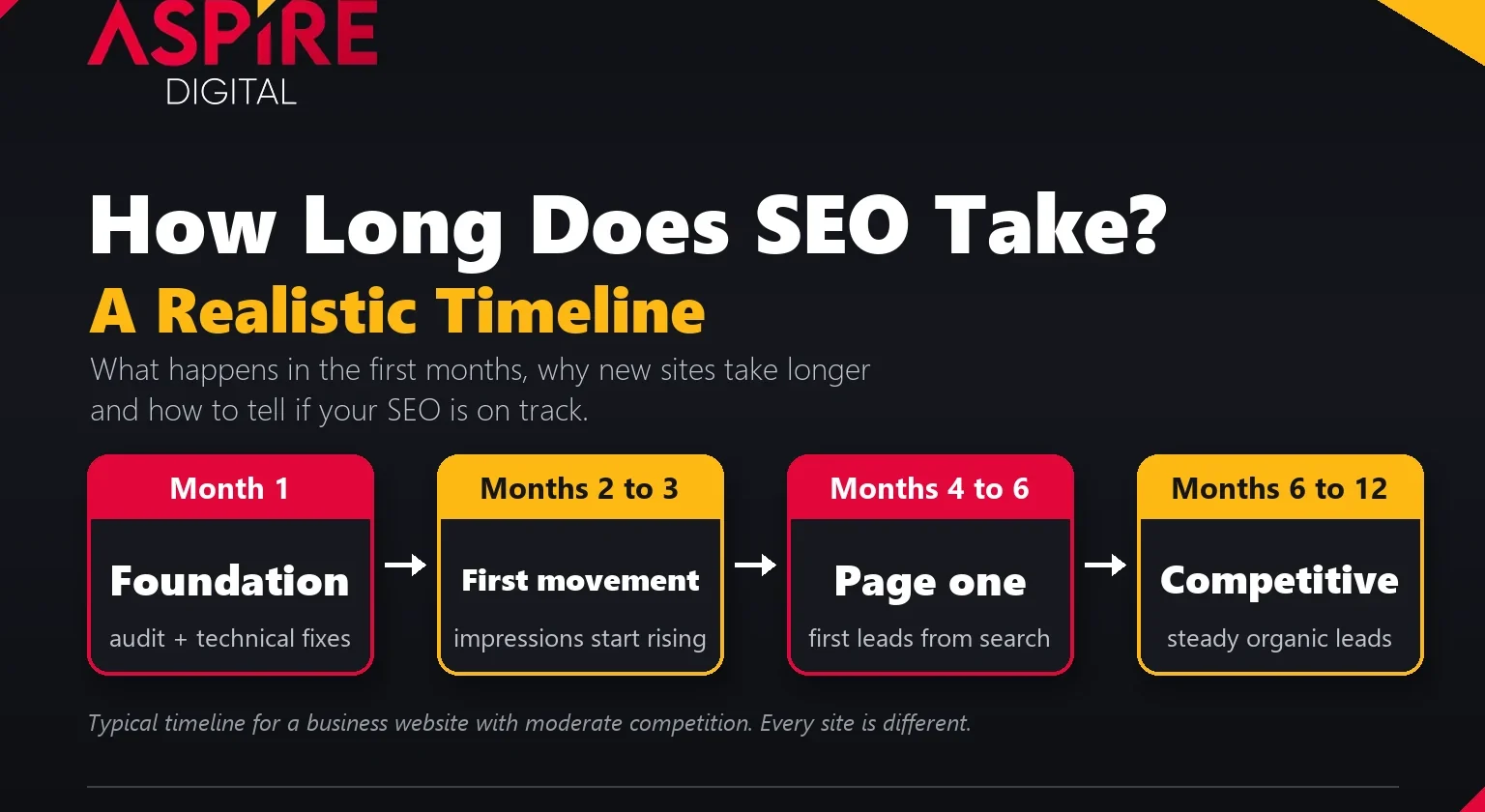
SEO progress by month: a realistic timeline
Every campaign is different, but for a typical small or medium business website in Pakistan with moderate competition, SEO progress by month usually looks something like this.
| Period | What the work focuses on | What you should see |
|---|---|---|
| Month 1 | Audit, technical fixes, keyword research, Google Search Console and analytics set up, sitemap submitted | Errors going down, pages getting indexed. Little or no change in traffic yet. |
| Months 2 to 3 | On-page optimisation of key pages, new service or location pages, first content, Google Business Profile | Impressions rising in Search Console. First rankings for long-tail and local searches, often on pages 2 to 3. |
| Months 4 to 6 | More content, internal linking, link building, improving pages that are close to page one | Some keywords reaching page one. Organic clicks growing. First enquiries clearly coming from search. |
| Months 6 to 12 | Competitive keywords, refreshing older pages, building authority | Main keywords climbing. Steady monthly leads from organic search. |
| 12 months and beyond | Holding positions, expanding into new topics and services | Results compound. New pages rank faster because the site is trusted. |
Month 1: foundation
The first month is mostly invisible to the business owner, and that is normal. A proper audit finds what is holding the site back: slow pages, crawl errors, missing titles, thin pages, indexing problems. Tracking is set up so that later progress can actually be measured. If your agency skips this and jumps straight to "posting blogs", be cautious.
Months 2 to 3: first movement
Once the site is clean and the key pages are optimised, Google starts showing it for more searches. The first sign is usually in impressions, not clicks: your pages appear in results more often, even if they are not yet high enough to get many visits. Long-tail and local searches tend to move first.
Months 4 to 6: rankings and leads
For most businesses, this is when SEO results show up in a way that matters: calls, forms and WhatsApp messages from people who found the site on Google. Pages that were sitting on page two start moving onto page one, often helped by internal links and a few good backlinks.
Months 6 to 12: competitive keywords
Broad, high-value keywords usually take the longest. By this stage the site has more pages, more links and more history, which is what it needs to compete for the searches your bigger competitors already hold.
SEO for a new website: why it takes longer
SEO for a new website is slower because Google knows nothing about it yet. There are no links pointing to it, no history of users finding it useful, and often only a handful of pages. Research backs this up. In a 2025 study by Ahrefs, only 1.74% of newly published pages reached the top 10 within a year, and the average page ranking at number one was about five years old.
That does not mean a new website cannot get results in its first year. It means you should aim at the right searches first:
- Start specific. Target service-plus-area and long-tail searches before broad national keywords.
- Get indexed properly. Add the site to Google Search Console, submit an XML sitemap and check that key pages are indexed.
- Set up your Google Business Profile. For local businesses, the map results can bring calls while the website is still building authority.
- Build one strong page per service. A clear, detailed page for each thing you sell gives Google something definite to rank.
- Earn your first links. Business directories, suppliers, industry associations and local press are realistic early sources.
A real example: page one in three months
When we started working with World Wide Electronics, a Karachi SMD LED display supplier, their website had zero organic visitors and no rankings. In the first month we fixed 40+ crawl errors, rebuilt the site structure and raised the PageSpeed score from 28 to 71. Rankings started appearing in month two. By month three, 15+ keywords were on page one, organic traffic passed 1,400 visits a month and the business was getting 20 to 30 organic enquiries a month.
Three months is on the faster side, and it is worth being clear about why it worked: the site had serious technical problems that were holding it back, the product keywords were specific, and competition in that niche was moderate. A business chasing a very crowded keyword should plan for longer.
So, how long does SEO take for your business?
A rough way to set your own expectations:
- Low competition, local or niche keywords: often 2 to 4 months for first page-one rankings.
- Moderate competition, established website: usually 3 to 6 months for clear improvement.
- High competition or a brand new website: plan for 6 to 12 months or more.
A good agency should be able to tell you which group your main keywords fall into after looking at your website and your competitors, before you sign up.
How to tell if your SEO is on track
Results do not appear all at once. They show up in a fairly predictable order, so you can check progress long before leads arrive. Open Google Search Console once a month and look for this sequence:
- Indexed pages: your important pages are indexed, with no growing list of errors.
- Impressions: the number of times your pages appear in search is rising.
- Average position: your target keywords are moving up, even if they are still on page two or three.
- Clicks: more visits from Google, especially to service pages, not only blog posts.
- Leads: calls, forms and WhatsApp messages you can trace back to organic search.
If impressions and positions are moving up, the work is heading in the right direction even before clicks catch up. For practical ideas on what to work on next, see our list of 10 SEO strategies to boost your ranking.
Warning signs your SEO is not working
- No reporting. You should get a monthly report showing what was done and how rankings, traffic and leads changed.
- Guaranteed number one rankings in weeks. No one can promise this. Google does not sell organic rankings.
- Flat impressions after 4 to 6 months. If your pages are not appearing in search more often by then, something is wrong with the strategy or the work.
- Rankings for the wrong keywords. Ranking for searches nobody makes, or that will never lead to a sale, looks good in a report but does not bring business.
- Traffic but no leads. Visitors arrive but nobody calls. This usually points to the wrong keywords or weak service pages.
How to get SEO results faster
You cannot force Google to move faster, but you can stop wasting the months you have. These steps usually shorten the SEO timeline the most:
- Fix technical problems first. Speed, crawl errors and indexing issues limit everything else.
- Improve pages that are almost there. Pages ranking in positions 8 to 20 are the quickest wins. Better content and a few internal links can push them onto page one.
- Target searches you can win now. Build traffic on specific keywords while authority builds for the broad ones.
- Give every service its own page. Clear pages convert better and rank for more searches.
- Link your pages together. Internal links help Google find new pages faster and understand which pages matter most.
- Stay consistent. Stopping and starting resets momentum. Steady monthly work compounds.
- Combine with ads if you need leads now. Google Ads can bring enquiries from day one while SEO builds the long-term flow.
If you want a straight answer for your own website, we offer a free SEO audit. We look at your site, your keywords and your competitors, and give you a realistic timeline before you commit to anything.
Related guides: What Is SEO? Complete Guide to Ranking | 10 SEO Strategies to Boost Your Ranking
Frequently asked questions
How long does SEO take to show results?
For most business websites, the first clear improvement shows in 3 to 6 months. Low-competition local keywords can move in 2 to 4 months, while competitive keywords and new websites often take 6 to 12 months or more.
Can SEO work in one month?
Small technical fixes and updates to existing pages can show an effect within weeks, especially if the site had serious problems. Real growth in traffic and leads usually takes several months of consistent work.
How long does SEO take for a new website?
Usually longer than for an established site, often 6 to 12 months for meaningful traffic. Start with specific local and long-tail keywords, a Google Business Profile and one strong page per service to get early results.
Why do my rankings go up and down in the first few months?
Movement is normal while Google works out where your pages fit, especially after new pages are published or updated. Look at the trend over several weeks, not daily changes.
Do I need to keep doing SEO after I rank on page one?
Yes. Competitors keep improving their pages, and Google keeps updating how it ranks results. Ongoing work protects your positions and helps you rank for new searches.
How do I know if my SEO is working before I get leads?
Check Google Search Console. Rising impressions and improving average positions for your target keywords are early signs that the work is moving in the right direction.


1 comment