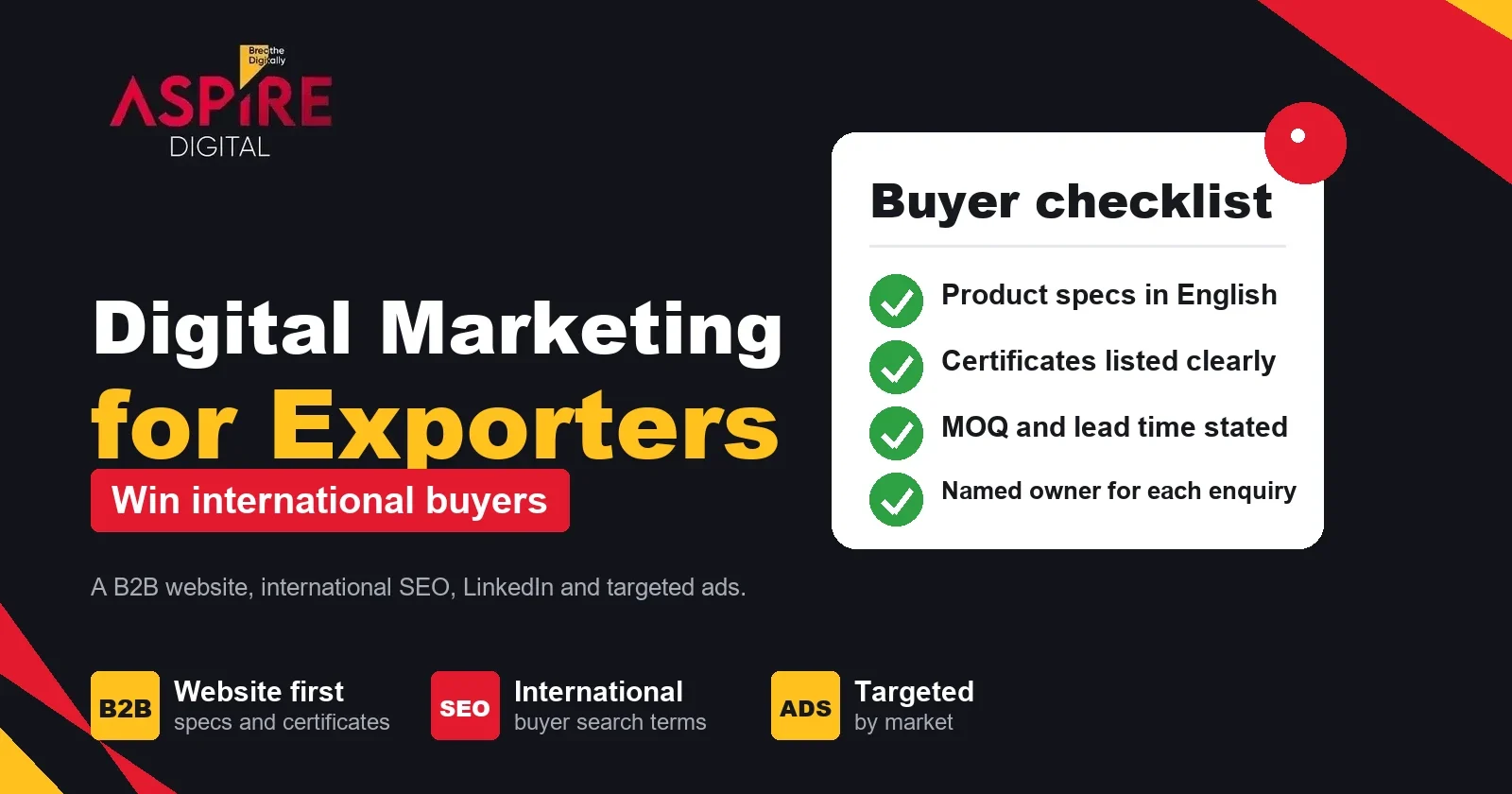
Quick answer: Digital marketing for exporters helps overseas buyers find your business, trust it and get in touch. For a Sialkot manufacturer, the core system is a B2B website with clear product and certification details, international search visibility, LinkedIn and targeted ads. Start with the website, then add one channel at a time and track which bring qualified buyers.
Sialkot is one of the most export-focused cities in Pakistan. Its manufacturers sell to importers, distributors and sourcing teams in many countries, and those buyers usually judge a supplier online long before they request samples. If you want a team that builds export-ready websites, international SEO and B2B campaigns, our digital marketing agency in Sialkot works with manufacturers and exporters. This guide explains what to build first and how to tell whether it is working.
Why exporters need marketing that reaches buyers abroad
An export buyer rarely calls a factory from a cold lead list. They search for a product type, compare a few suppliers, check the website for specifications and certificates, look at the company on LinkedIn and then send an enquiry. If any step looks weak, the buyer moves to the next supplier, often without telling you why. Digital marketing fills those gaps, so the buyer can find the right information quickly.
Sialkot's reputation is built on products such as footballs, field hockey sticks, cricket equipment, boxing gloves and precision instruments, as the Associated Press of Pakistan feature on Sialkot's export industry describes. That reputation is a strong starting point, but a buyer in another country cannot see your factory floor. Your website and online presence have to show the quality, capacity and reliability that a visit would prove.
Map the buyer journey before you pick channels
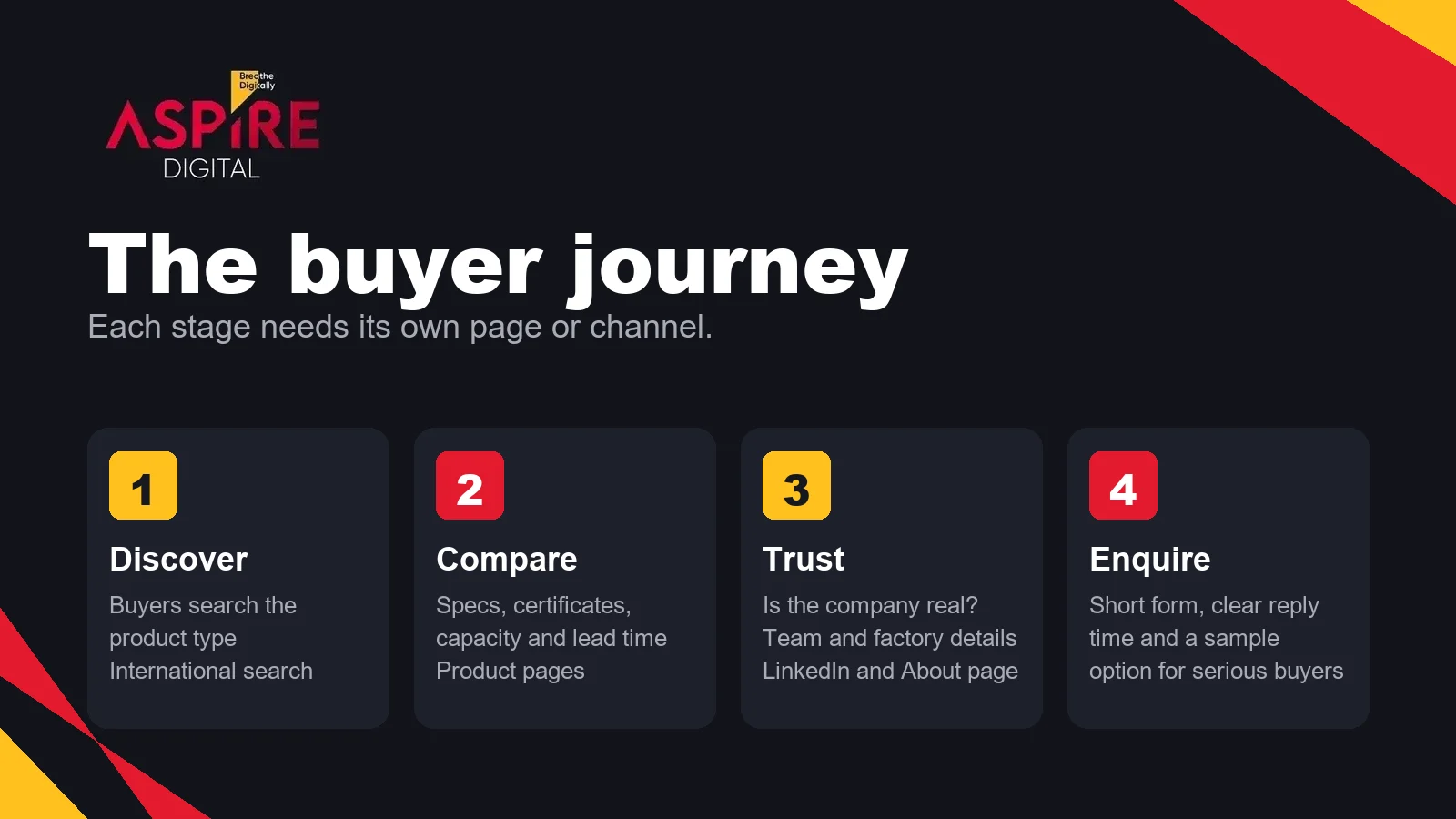
Each stage of the buying process needs different content and a different channel. The table below shows a simple map that most exporters can use to plan their work. Start with the stages where you lose the most enquiries, because those are the fastest to improve.
| Buyer stage | What the buyer checks | Best channel | What to build |
|---|---|---|---|
| Discovery | Which suppliers make this product? | International search and Google Ads | Product category and product pages in English |
| Comparison | Certifications, capacity, minimum order and lead time | Website and search results | Specification sheets, certificates and clear terms |
| Trust | Is the company real, and who is behind it? | LinkedIn and the company website | About page, team profiles, factory details and case examples |
| Enquiry | How fast will they reply and how do I start? | Contact form, email and messaging | Short enquiry form, response process and a sample request option |
| Follow up | Can this supplier handle my market? | Email and LinkedIn outreach | Market pages, sales sheets and a clear next step |
Build a B2B website that answers buyer questions
Your website is the main sales tool for an exporter. It should answer the questions a buyer asks in the first five minutes. Show product categories clearly, with specifications, materials, sizes and finishes. List certifications and quality standards you hold, and explain the production process in plain language. Add the minimum order quantity, the usual lead time and the way you package and ship goods. If a buyer has to email you to learn basic facts, many will not bother.
Write product pages in English that buyers in your target markets would use, not only the technical names used in your factory. A buyer may search for "custom football manufacturer" while your team says "moulded ball production line". Include both terms, so the page matches how the buyer searches. For a fuller guide to making a site work for buyers in other countries, read our article on hreflang and targeting several countries.
Use international SEO for the search terms buyers type
International SEO helps your pages rank when buyers in other countries search for products you make. It covers the words buyers use, the countries you want to reach, the technical settings for each market and the links that prove your company is real. Start with a short list of target products and markets, then build pages for the searches that match your capacity. Our guide on international SEO for exporters covers the steps in more detail.
Use LinkedIn to reach decision makers
Buyers in importing companies often include purchasing managers, product managers and owners. LinkedIn is where many of them research suppliers and check company credibility. Keep the company page complete, with the product range, locations and a link to the website. Ask your sales team and managers to write short posts about production, quality checks, new products and trade shows. Personal posts from real people usually get more attention than logo-only posts, so share how your team solves a specific problem for a customer.
Outreach needs care. Send short, relevant messages to people who work in the market you serve, explain why your product fits their range and ask one clear question. Long sales pitches on the first message usually get ignored, so keep the first contact short and useful.
Run B2B ads in the markets you can serve
Search ads can reach buyers who already know the product they need. Target the countries you can ship to, choose product terms that buyers use and add negative keywords for students, job seekers and buyers of unrelated items. Send the ad to a product page or a landing page that matches the search. LinkedIn ads can target job titles and industries, which suits premium products or custom orders. Track every enquiry source, because a campaign that brings many visitors but no serious buyers is not working.
Respond to enquiries quickly and track what happens
Marketing creates the enquiry, but the reply decides whether it becomes a sale. Set a clear response process, with a named person for each market, a standard reply time and a short list of questions to ask. Record each enquiry by country, product, order size and source, so you can see which channels bring real buyers. Review the list every month and drop the channels that bring many enquiries but few serious orders.
Use trade shows and marketplaces as a complement
Trade fairs and B2B marketplaces can open doors that search and LinkedIn cannot, especially for buyers who want to see samples in person or compare several suppliers in one place. Treat them as a complement to your website, not a replacement. Before you exhibit or list on a platform, decide which products you will promote, prepare a one-page profile with specifications and certificates, and set up a follow-up process for every contact. Each lead from a fair or marketplace should go into the same enquiry record as your website leads, so you can see which source produces real orders.
Common mistakes exporters make online
- A website with the product catalogue but no specifications, certificates or lead times.
- Using only local Pakistani keywords when buyers search in English from other countries.
- Sending every enquiry to one shared inbox with no owner or response time.
- Sharing only logo posts on LinkedIn, with no information a buyer can use.
- Running ads to the homepage instead of a page that matches the product searched.
- Judging success by website visits rather than qualified buyer conversations.
For the wider context of how overseas buyers and clients find Pakistani companies, see our guide on digital marketing services in Dubai, which covers how businesses that sell across borders plan their online presence.
Exporter digital marketing checklist
- Product pages in English with specifications, materials, sizes and finishes.
- Certifications and quality standards listed in a downloadable sheet.
- Minimum order quantity, lead time and shipping terms stated clearly.
- About page with the factory, team and production process explained.
- Target markets chosen, with keywords checked for each one.
- Complete LinkedIn company page and a posting plan for the sales team.
- Enquiry form with a named owner and a set reply time.
- Monthly review of enquiries by country, product and source.
Related guides: Digital Marketing Services in Dubai: Guide, Digital Marketing for E-Commerce Businesses and International SEO for Exporters.
Frequently asked questions
What is digital marketing for exporters?
It is the set of online activities that help overseas buyers find, compare and contact an exporting business. It usually includes a B2B website, international SEO, LinkedIn activity and targeted ads. The goal is qualified buyer enquiries, not only traffic.
Should a Sialkot exporter start with SEO or ads?
Start with the website, because both SEO and ads send buyers to it. Once the product pages and enquiry process are clear, search ads can bring buyers quickly, while SEO builds steady visibility over time. Many exporters use both, with ads covering the products they want to push now.
Is LinkedIn useful for small manufacturers?
Yes, when the company page is complete and the team posts useful content regularly. LinkedIn helps buyers check that the company is real and that its people are active. It works best alongside a clear product range and a fast enquiry process.
How do I know if digital marketing is bringing real buyers?
Record every enquiry with its country, product, source and order size. Then compare how many enquiries turn into samples, quotations and orders for each channel. Judge the channels on those outcomes, not only on visits or likes.