Quick answer: School admissions marketing works best as a steady system, not a one-off advert. Show parents your campus, results and fees in search and on social media, reply to every enquiry quickly, and follow up until the family decides. Track where each enquiry comes from, so you know which channels bring students.
Schools and colleges that want a steady flow of applicants can work with a team that offers digital marketing for educational institutes. This guide explains the steps you can take yourself, what to measure, and where most schools lose enquiries without noticing.
Why admissions marketing is different
Parents do not choose a school the way they choose a phone case. They compare several options, ask friends, visit campuses and often decide over weeks or months. Your marketing has to build trust at each step, and it has to be ready before the admission window opens, not after it.
For most families the questions are simple: is this school right for my child, and can I reach someone quickly if I have a question? Every part of your online presence should answer those two questions.
Map the parent journey first
Before you choose channels, write down the steps a parent takes from the first search to the admission form. The table below is a simple version you can adapt for your school.
| Stage | What the parent is asking | What to publish |
|---|---|---|
| Research | Which schools are near me, and which teach what my child needs? | A Google Business Profile for each campus and a clear school page |
| Compare | How do fees, facilities and results differ? | Fee structure, admission steps, results and real campus photos |
| Decide | Can I trust this school, and what happens next? | Parent reviews, a tour or open day booking, and a quick reply to every enquiry |
| Enrol | What documents do I need, and by when? | A document checklist, deadlines and a named contact person |
Make sure families find each campus on Google
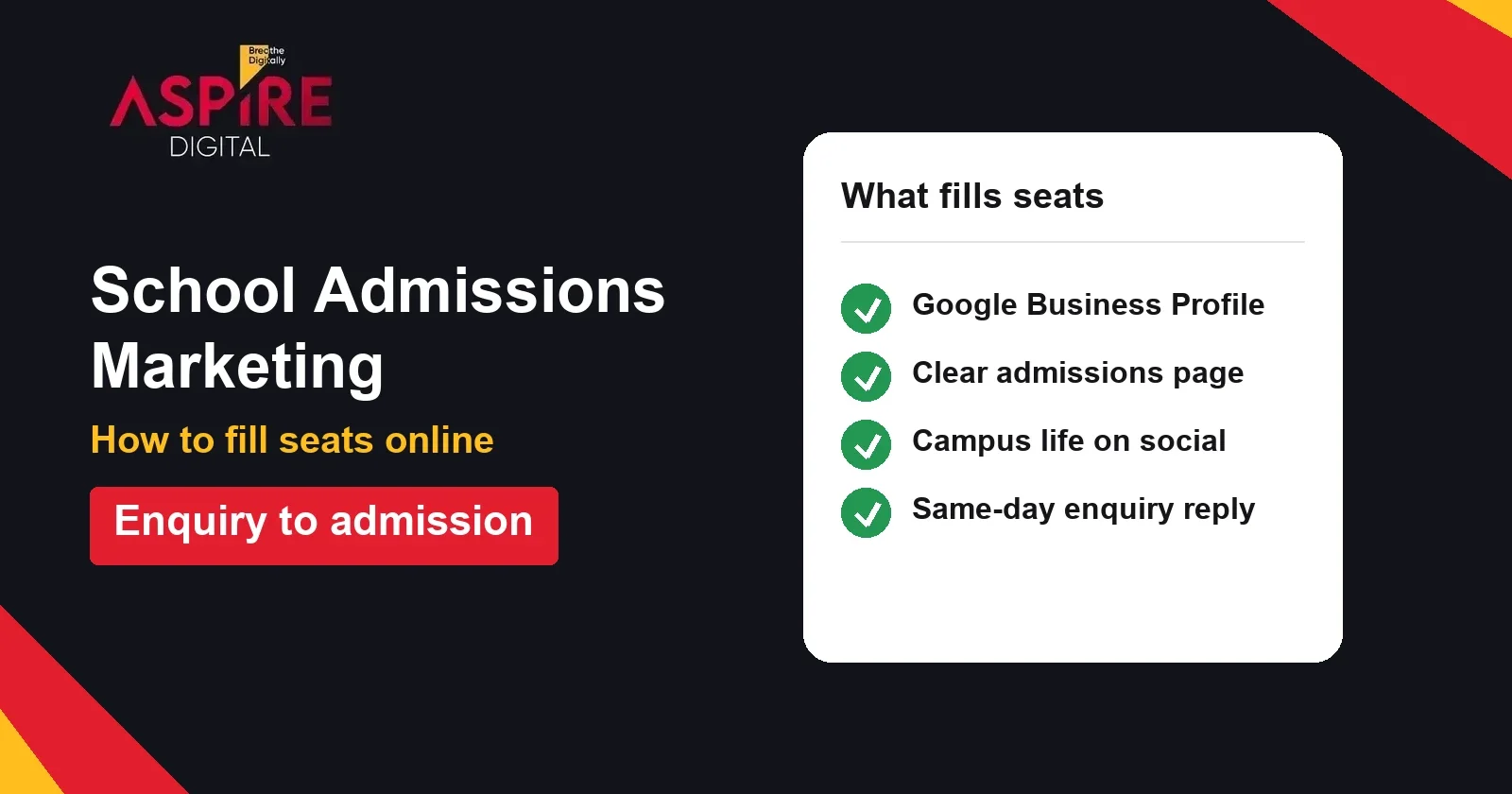
Many parents search for a school by area before they search by name. Each campus should have its own Google Business Profile with the correct address, phone number, hours, photos and admission contact. Mismatched addresses and duplicate listings confuse both Google and parents, so check that every campus appears once and that its details match your website.
Reviews matter here too. Ask parents who had a good experience to leave a review, and reply politely to every review, including the critical ones. For the full profile checklist, read Google Business Profile Optimization: A Step by Step Guide for Karachi Businesses.
- Campus address, phone number and hours match the website exactly
- Photos of the entrance, classrooms and sports areas
- An admissions contact shown on the profile
- Reviews asked for, and every review answered
Build an admissions page that answers questions
Your admissions page is where enquiries turn into applications, so it needs more than a logo and a list of programmes. Show the fee structure, the admission steps, the documents needed and the deadlines. Place one clear form near the top, and offer a phone or WhatsApp option for parents who prefer to talk.
Check that the page works well on a phone. Many parents will open it while they are on the move, so slow pages and small buttons lose enquiries.
- Fee structure in plain language
- A step-by-step admission process
- A document checklist
- An open day or campus tour booking form
Use search to answer the questions parents ask
Parents search with questions such as "how do I apply to a school in Karachi" or "what documents are needed for admission". Pages that answer these questions directly can bring enquiries long before a family is ready to compare schools by name. Use your focus words in the page title, the first paragraph and the headings, and write for the parent rather than for a search engine.
Keep each page focused on one question. A separate page for each campus, programme or admission process usually works better than one long page that tries to cover everything.
Show campus life on social media
Social media is where parents see the school in action. Post what they want to see: classrooms, sports, science fairs, school trips, teachers at work and the achievements your students have earned. Short videos of a real school day often tell the story better than a brochure.
Before you post photos of children, get written consent from parents and follow your school's own policy. Do not show a child's name in a caption next to their face, and remove any image a family asks you to take down. For a wider view of how these posts fit into a plan, read Social Media Marketing for Steady Growth.
| Content type | What it shows | Best use |
|---|---|---|
| Campus tour video | The building, classrooms and a typical day | Open day promotion and the admissions page |
| Teacher spotlight | Who teaches and how they work with students | Building trust before the first visit |
| Results and events | Achievements, competitions and school fairs | Ongoing engagement and reviews |
| Parent testimonial | Why a family chose the school | The decision stage, with written consent |
Run ads for enquiries, not just reach
Paid ads help when a school needs enquiries in a specific window, such as the weeks before admissions open. Use location targeting around each campus, and send every ad to a page that matches its message. A parent who clicks an ad for an open day should land on an open day form, not on the homepage.
For search ads, focus on the questions parents ask and on the school name, and tie the budget to the campuses that can take new students. Reduce or pause ads for a programme that is already full. The main lesson in Digital Marketing for Small Businesses in Karachi applies here too: match each channel to one clear goal.
Reply fast and follow up
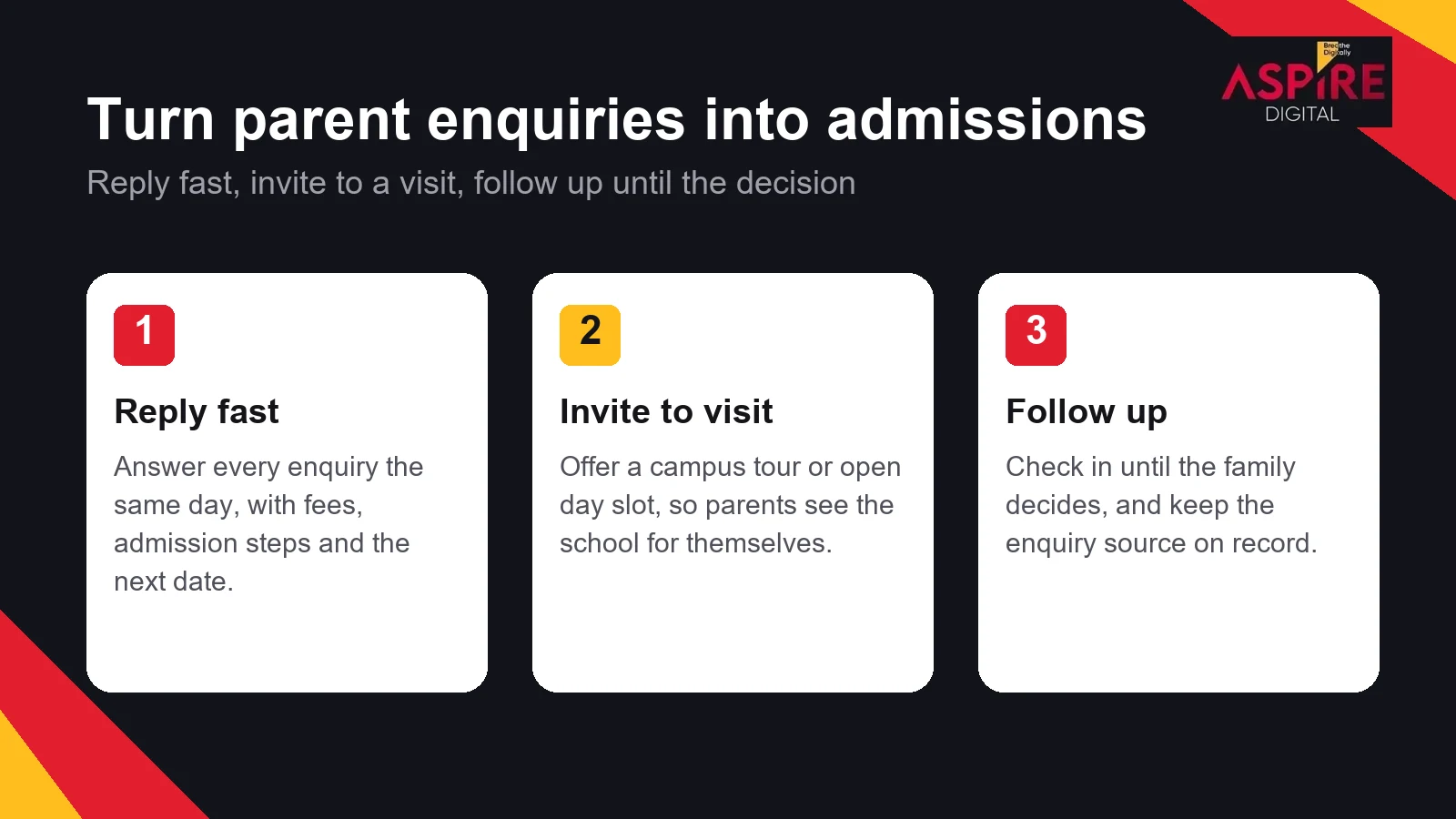
Most school enquiries are lost after the first message, not before it. A parent who asks about fees and waits three days for an answer often calls another school. Set a rule that every enquiry gets a reply on the same working day, even if the full answer follows later.
- Log every enquiry with its source, such as Google, Instagram, a specific ad or a referral.
- Reply with the fee structure, the admission steps and the next date.
- Offer a tour or open day slot, and confirm it in writing.
- Follow up after a few days if the family has not answered.
- Record the outcome, so you can see which channels lead to admissions.
Measure enquiries and admissions, not likes
Marketing is working when enquiries rise and more of them become admissions. Likes and views are useful signals, but they are not the goal. Set up tracking so that each enquiry can be traced back to its source.
| Metric | Why it matters | How to track it |
|---|---|---|
| Enquiries by source | Shows which channels bring parents | A source field on forms, separate phone numbers, and UTM links on ads |
| Tour and open day bookings | Shows which enquiries are serious | The booking form and one shared sheet |
| Enquiry to admission rate | Shows how well the team follows up | The admissions register matched against the enquiry log |
| Cost per admission | Shows whether paid ads are worth the money | Ad spend for a channel divided by the admissions it brought |
A simple plan for the next admission season
Start with the steps you can control this month. Schools that work through these in order usually have a clear picture of their results by the time the season peaks.
- Check that every campus is listed correctly on Google, with one profile per campus.
- Update the admissions page with fees, steps, documents and a clear form.
- Plan a steady run of campus videos and photos, with parent consent.
- Set up enquiry tracking and a same-day reply rule.
- Test a small ad budget for each campus, then move money to the channel that brings admissions.
Related guides: Digital Marketing for Small Businesses in Karachi, Social Media Marketing for Steady Growth
Frequently asked questions
How early should a school start admissions marketing?
Start before your admission window opens, so your Google profiles, admissions page and social posts are ready when the first enquiries arrive. Parents often research for weeks, so visibility built early helps more than a last-minute push. Use the enquiry data from the last season to decide the timing.
Is social media enough to fill seats?
Usually not on its own. Social media builds familiarity and trust, but parents still search on Google, read reviews and visit the campus. Combine social posts with a strong Google profile, a clear admissions page and a fast reply process.
Can we use photos of students in our marketing?
Only with written consent from the parents or guardians, and in line with the school's own policy. Avoid naming children in captions, and remove any photo that a family asks you to take down.
Which channel brings the most admissions?
There is no single answer for every school. Track enquiries by source for one full season, then put more budget into the channels that bring students who actually enrol, not only the ones that bring the most clicks.